Product
GridCast v1.2 and v1.3

Olivier Corradi
The speed of iteration from GridCast is showing
We have shipped two new model versions to production, jumping straight from v1.1 to v1.3
v1.2
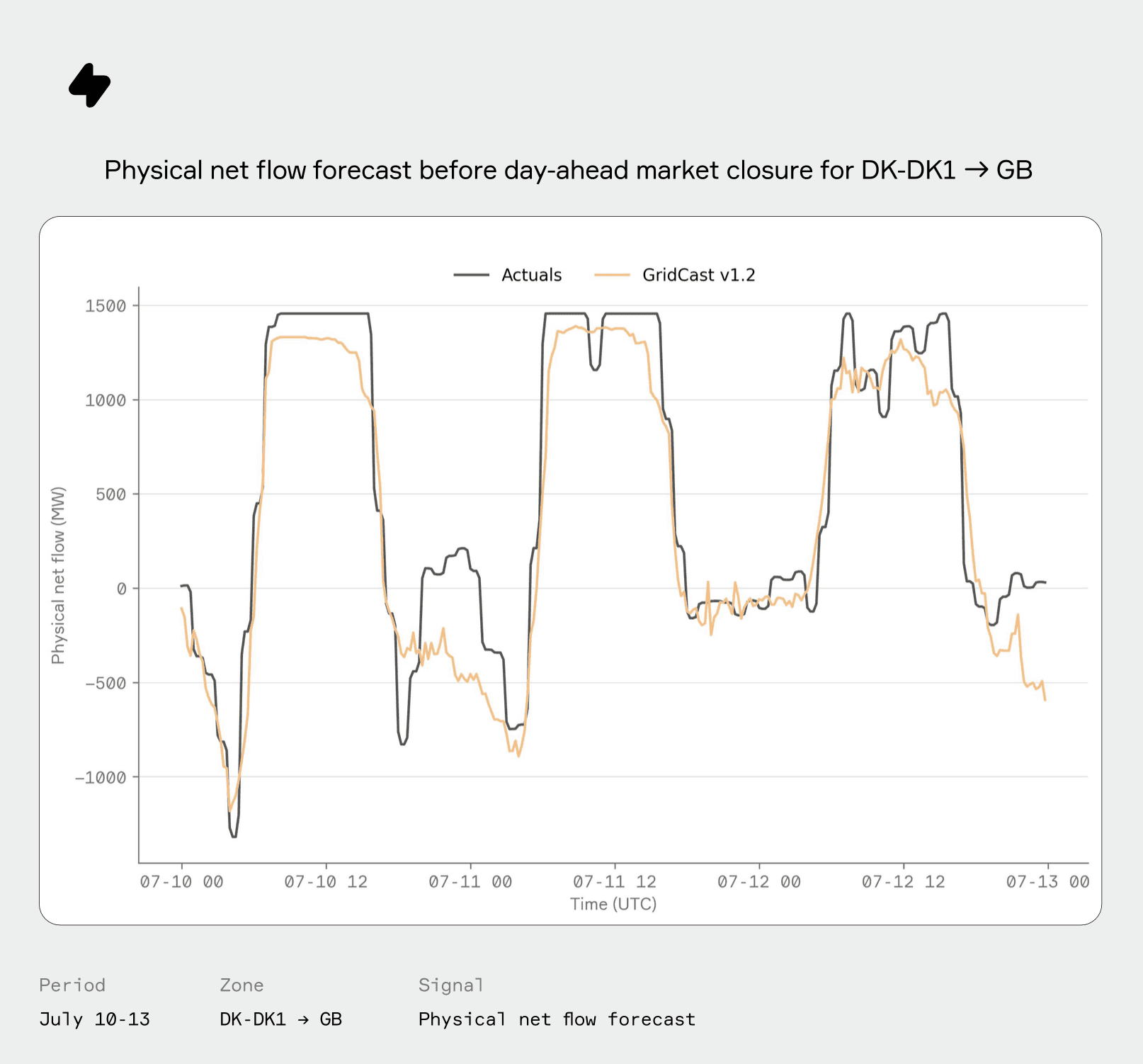
The first iteration brought our cross-border flow forecasts into the same approach we already use for day-ahead prices.
The exchange models now run on our own proprietary load, wind and solar forecasts, which takes into consideration the net load balance on both sides of a border instead of looking at one zone in isolation.
Net load spreads are now the single biggest driver of these models, responsible for 27 to 58% of feature importance depending on the border. Weather and calendar still matter, they're not being replaced, but the model now understands the whole neighborhood around a border, not just one side of it.
v1.3
The second iteration changed how we train wind, solar, load and day-ahead price models. Instead of one model covering the whole forecast horizon, we now train separate models for each lead-time band: 6 for every fundamental signal, 3 for day-ahead price.
Up close, recent observations and TSO forecasts matter most. For DK-DK2 wind at 0 to 6 hours out, the TSO forecast alone accounts for 37% of the model's improvement. Further out, weather takes over, at 48 hours and beyond, two AIFS wind-speed features contribute 69%. By splitting the horizon, each model now specialize rather than compromise.
We also cut training time so now every model retrains every 7 days instead of every 30, on a deduplicated dataset roughly 98% smaller, and all of them run on AIFS, our first AI-based weather model.
With the new model releases, every wind and solar signal we forecast improved, 14 out of 14, against v1.1.1. Every day-ahead price signal improved too, 7 out of 7. The model trains itself about 4 times faster, which means the next improvement is closing in faster than before.
Two results stood out in particular: the error on the top 5% of French day-ahead prices dropped by almost 8 percentage points, and the error on negative-price hours in Great Britain dropped by close to 5 percentage points.

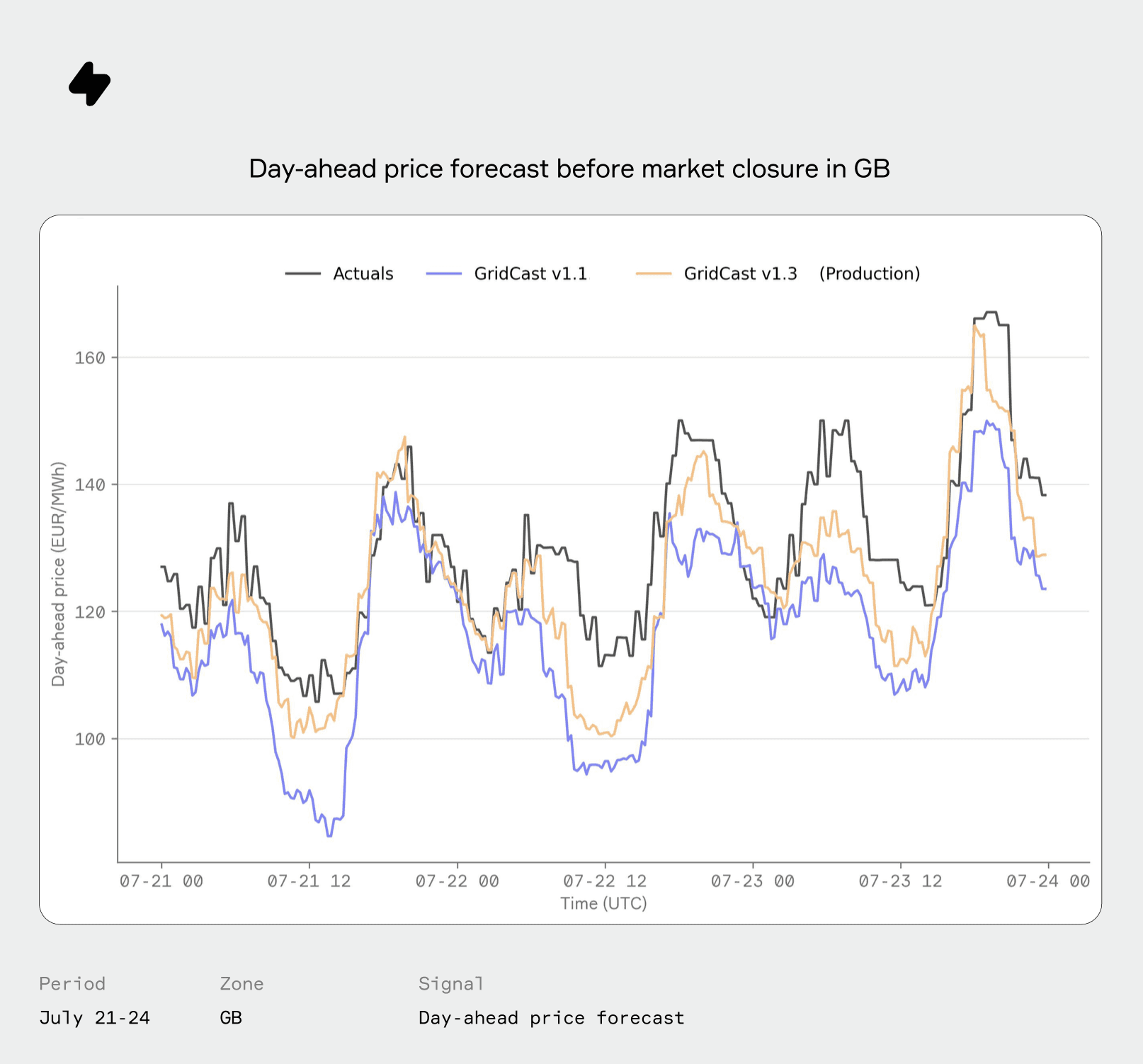
You can see it too in Germany, where the new model held much closer to the actual price during the July spike.
We see the grid on both sides of every border and at every point on the forecast horizon. Running the world’s most comprehensive electricity data platform lets us keep building forecasts that are more accurate, and GridCast has made it possible for us to iterate much faster.


