Video
Back
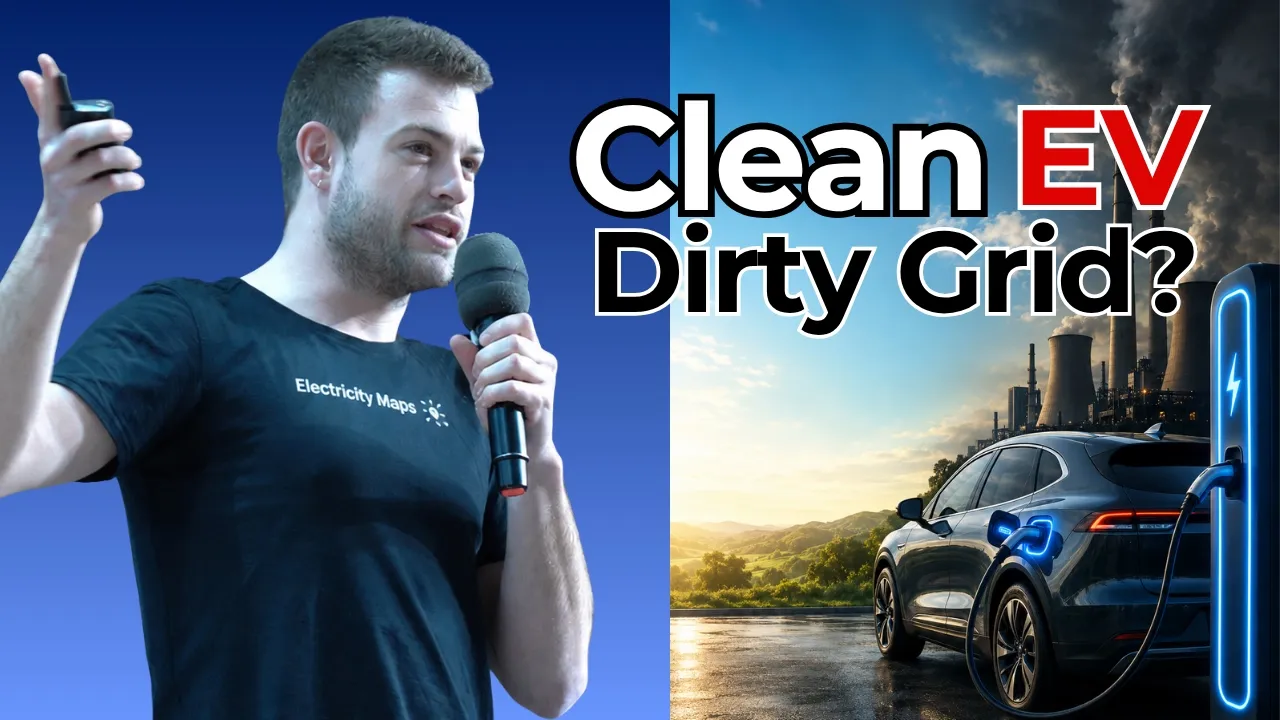
Are EVs Still Clean on a Dirty Grid?
Julien Lavalley of Electricity Maps explains how EV charging emissions vary by country, time of day, and electricity mix, and why EVs remain cleaner than combustion vehicles over their lifetime, even on imperfect grids. With live data examples from Canada, the US, California, Alberta, Ontario and more.
Battery electric vehicles produce fewer lifetime emissions than internal combustion engine vehicles regardless of grid cleanliness. The wide range in EV lifecycle emissions comes almost entirely from one variable: the carbon intensity of the electricity used for charging.
Carbon intensity varies by location
Every grid runs on a different mix of generation technologies, which means carbon intensity, measured in grams of CO2 per kilowatt-hour, differs significantly from one region to the next. California's large renewable capacity puts it far below Virginia. In Canada, Quebec's hydro grid sits in a different category from Alberta's or Saskatchewan's. Treating Canada or the US as single regions misses most of the variation that matters for EV charging decisions.
And by time of day
In California, solar generation brought carbon intensity down to 65 gCO2/kWh at midday. By midnight the same grid was at 180 gCO2/kWh. Alberta swings with wind and solar availability throughout the day. Ontario's nuclear and hydro fleet holds a stable baseline, but gas generation rises with daytime load, making overnight charging considerably cleaner than evening charging.
Charging time makes a concrete difference
In Alberta on May 17th 2025, midday charging meant under 300 gCO2/kWh. Charging a few hours later in the evening pushed that above 400 gCO2/kWh. Across most Canadian grids, carbon intensity can double or triple between the cleanest and dirtiest hours of the year.
Grids are decarbonising
Alberta's carbon intensity has fallen from over 500 gCO2/kWh in 2018 to around 300 today. Australia dropped from 650 in 2017 to 450 in 2026. As grids decarbonise, the emissions from EV charging fall with them, with no change to the vehicle required.
Vehicle-to-grid
Smart charging and V2G applications allow EV batteries to absorb surplus renewable generation and return energy during peak demand, adding flexibility to grids and supporting further decarbonisation.
The Electricity Maps platform is free on web and mobile. Carbon intensity data for any grid region is available in real time.

